Evolution of Jew-Hatred
The term Judeophobia, meaning “fear of Jews,” originated during the Roman era and remained in use until the end of the Renaissance. During this period, Jews were primarily targeted for their religion — especially due to their refusal to assimilate into dominant societies. Forced conversions were common, and those who resisted often faced violent persecution and systemic exclusion.
With the rise of the Enlightenment, a new term emerged: Judenhass, or “Jew-hatred” in German. This form of hatred was rooted not only in religion but also in resentment toward the social and economic success of Jews. Jews were increasingly targeted for their race — a fusion of their religion, culture, and ethnicity — and were seen as an obstacle to national unity and equality.

In 1879, Wilhelm Marr introduced the term antisemitism, which marked a further racialization of Jew-hatred. Antisemitism is the hostility or hatred toward Jews based on their religious, ethnic, cultural, or racial identity. It targets Jews for who they are, and throughout history, antisemites have used this ideology to justify the exclusion, dehumanization, oppression, persecution, and even extermination of Jews.
Antizionism emerged in the late 19th century but gained ideological momentum during the Russian Revolution, when it became a political tool to oppose the Jewish right to self-determination. In 1916, Vladimir Lenin referred to Zionism as “bourgeois imperialism." This was the first antizionism libel that planted the ideological seeds of what would later become the “colonizer” libel against the Jewish people. This framing portrayed the Jewish national movement not as a fight for self-determination, but as an extension of Western imperialist power. The Soviet Union designed antizionism into ideological and geopolitical weapon. After the founding of the State of Israel in 1948, the Soviet Union launched a widespread anti-Israel propaganda campaign. Its objectives were to gain influence among Arab nations, undermine Western alliances, and suppress Jewish identity within its own borders. In the wake of the Holocaust, open Jew-hatred had become socially unacceptable, so Soviet leaders substituted the word “Jew” with “Zionist.” This shift allowed them to repackage traditional antisemitism in political terms—portraying it as opposition to Zionism or imperialism—thereby giving antisemitic rhetoric a renewed platform under the guise of political ideology. This Soviet strategy helped normalize antizionism across leftist movements worldwide, embedding a new form of Jew-hatred in international political discourse. Unlike earlier forms of Jew-hatred, antizionism specifically targets Jews for their national identity and their right to exist as a sovereign people in their ancestral homeland.
Antizionists deny Jewish identity, self-determination, nationhood, and statehood. They oppose the very idea of Jewish peoplehood and Israel’s existence. Just like older forms of antisemitism, antizionism is not about policy criticism — it is about delegitimizing the Jewish nation, and it often masks itself in political language while fueling global hatred against Jews.
Judeophobia (anti-Judaism), Judenhass (Jew-hatred), Antisemitism (anti-Jewish), and Antizionism (anti-Israel) are all forms of racism and hate. They are ideological mutations — evolving over time to adapt and survive, but always aimed at the same target: the Jewish people. Today, antisemitism and antizionism remain dangerous ideologies that threaten not only Jews, but the values of human rights, equality, and democracy everywhere.
%20(2).png)

The Cycle of Libels
The Engine of Jew-Hatred for Over Two Millennia
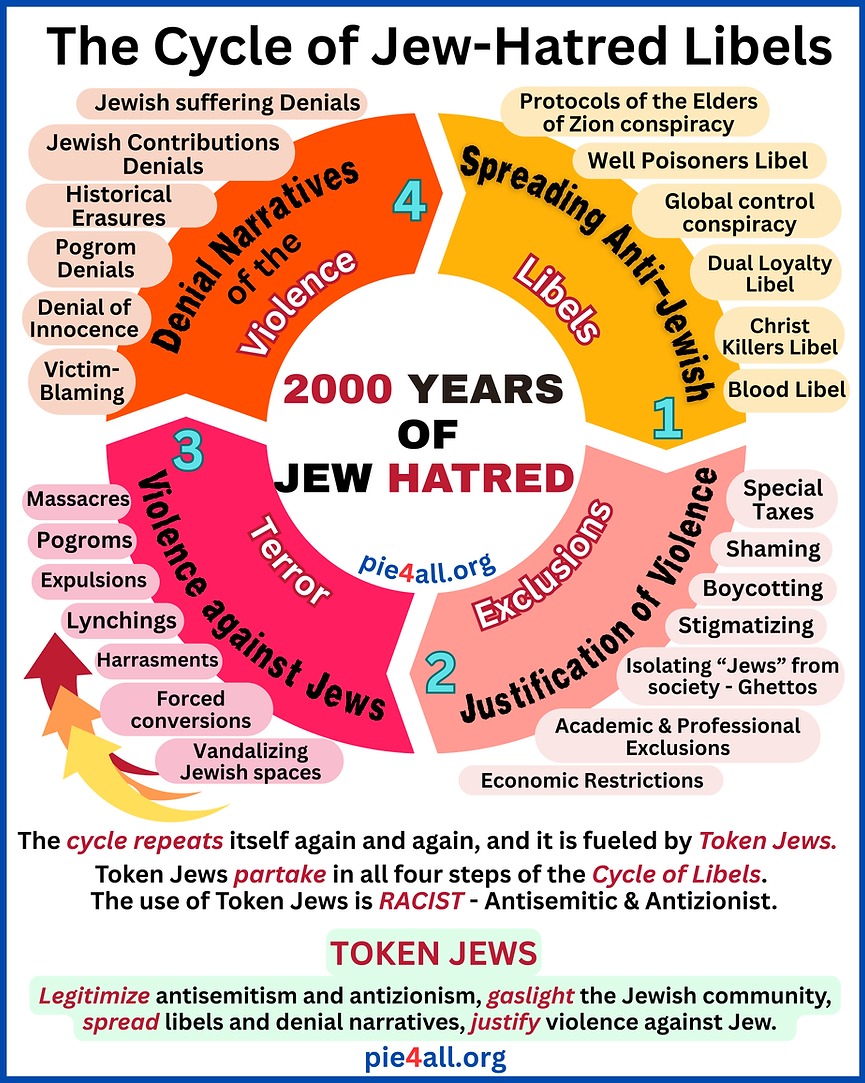
The essence of Jew-hatred has, for over two thousand years, been defined not by legitimate critique or rational discourse, but by a persistent cycle of libels and conspiracy theories. From ancient accusations of deicide and well poisoning to modern claims of global control and racial oppression, antisemitism has always relied on fabricated narratives to dehumanize Jews and justify violence against them. In the 20th century, this cycle underwent a critical transformation: during the Russian Revolution (1918) and the rise of the Soviet Union, a new set of antisemitic libels was manufactured under the guise of revolutionary and anti-imperialist language. The Soviet regime systematically promoted falsehoods labeling Jews and Zionists as "colonizers," "racists," "apartheid agents," and perpetrators of "genocide" — terms now central to the contemporary antizionist discourse. Although the Soviet Union collapsed after 80 years, the propaganda it institutionalized was never dismantled or intellectually discredited. These libels continue to fester in academic, media, and activist circles precisely because they were never meaningfully confronted. At each stage in this cycle, tokenized Jews — those detached from the Jewish collective — have been instrumentalized to validate the lies and gaslight the broader Jewish community. Jew-hatred functions like a virus: it mutates to survive, changing its rhetorical form while maintaining the same core function — the marginalization and delegitimization of Jewish existence. From Judeophobia (religious fear of Jews), to Judenhass (ethnic hatred), to Antisemitism (racial pseudoscience), and now Antizionism, this mutation has produced increasingly sophisticated ideological forms that embed themselves into public discourse.
Antizionism represents the latest mutation of this viral hatred. While it purports to critique the policies of the State of Israel, it frequently crosses the line into a wholesale denial of Jewish peoplehood, Jewish indigeneity, and Jewish self-determination. By framing Zionism, the national liberation movement of the Jewish people, as inherently racist, colonial, or oppressive, antizionism recycles classical antisemitic tropes under the guise of progressive ethics. These libels are presented in academic institutions, civil society, and online platforms not as bigotry, but as moral imperatives. In doing so, antizionism camouflages the ancient cycle in the language of social justice, rendering it more insidious and harder to confront. Its strategic use of "intersectionality" and selective human rights rhetoric masks the continuity between medieval blood libels and modern-day accusations of genocide against Israel.
This cycle is especially visible in Western educational settings, where antizionist discourse has become normalized. What begins as politicized language or selective historical framing soon transforms into hostile learning environments for Jewish students. Incidents in Ontario, Canada — where 781 antisemitic acts were reported in a single academic year — demonstrate that the cycle is fully operational: it starts with libels; spreads through curricula, peer behaviour, and educator silence; leads to harassment and assault; and concludes with institutional denial or reclassification of events as non-antisemitic. As the report reveals, nearly 60% of these incidents were antizionist in nature, and a staggering 57% of cases were either ignored or dismissed by school authorities. This evidences not just a failure of policy but a profound failure of moral clarity within educational leadership.
Antizionism is not a political ideology — it is a racist hate movement. Left unchallenged, it behaves like a metastasizing tumor: what begins as rhetorical aggression evolves into social exclusion, institutional complicity, and normalized violence. Antizionism today is not new; it is merely the Soviet-era propaganda playbook, repackaged for the digital age. Its ideological roots stretch from the Russian Revolution to the Cold War, where Jews were labeled "Zionist bourgeois nationalists" and stripped of rights, to today’s activists who seek to erase Israel from maps and Jewish identity from global discourse. The tactics have not changed — only the vocabulary has. To defeat this cycle, the antizionist playbook must be exposed, deconstructed, and delegitimized through education, policy, and public accountability. Awareness is not optional; it is the front line of Jewish communal defense.
Breaking the Cycle: Antizionism Must Be Named and Confronted
How the Cycle Operates in Educational Institutions
%20(41_6%20x%2052%20in).png)
.png)
.png)